You are heretonometers
tonometers
Home Eye Pressure Monitoring Recommended
Millions of people around the world should be monitoring their eye pressure (intraocular pressure) at home, according to health organizations (such as International Society for Self-Tonometry (ISST)) that are issuing recommendations on what to do and how to do it. Many experts, such as Dr. Graham Lee, feel the evidence is quite strong that home eye pressure monitoring leads to better control of intraocular pressure, and the evidence is quite strong that intraocular pressure control lowers the risk of glaucoma progression and optic nerve cell death.
Are air puff tonometers only for initial diagnosis or early warning?
i was always under the impression that the "puff air"
type tonometers were OK for initial diagnosis/early
warning indicators but
that real, true, accurate readings required
the contact tonometers
Where to get a Tonometer?
Hello, My husband Blake was diagnosed with Glaucoma about a year ago and we are currently searching for an affordable IOP measurement device he can use at home. Can you tell me where we might get one? Also, do you have an advice on the best model? If there are any studies, such as that described in the forum, he would be happy to take part. Kindest regards, Natina
EDIT: the replies below need to be updated for 2010. Please contact FitEyes directly before deciding which tonometer to purchase. See contact info below, or here: Contact
Can we estimate our eye pressure with our finger?
I am trying right now to get a feel of my pressure by just touchng the eyes with my index fingers. I can tell if it's high or low but I would like to become very accurate with the help of a tonometer. Which one do you recommend and what the difference in mg with for example a Goldman, Thanks.
Accurate home tonometers
Hi,
I just found your blog -- it is quite interesting. I have pigmentary glaucoma diagnosed ten years ago.
Here is my second question: Are there any accurate HOME tonometers out there that don't cost a fortune?
Thank you,
DB

The Comfort I Get From Monitoring My Eye Pressure
With the recent website upgrade to FitEyes.com, I decided to send an email to all registered member. While writing the email I was inspired to discuss more of my experiences with self-tonometry, the process of monitoring my own eye pressure. After I wrote and sent the email, I realized that we have a lot of visitors to FitEyes.com who are not registered and who would not be able to see the experiences and thoughts I shared with the registered members. Therefore, because I feel very passionate about the benefits of self-tonometry, I decided to post the entire email on my blog. Here it is (and now it is updated to reflect recent events such as my grandmother's most recent birthday).
Hi Everyone - I just upgraded the FitEyes.com website. It has been a long, long time since I have sent an email to all members. FitEyes has continued to grow and flourish in recent months. I want to take this opportunity to invite you to visit the new website and let me know what you think. Not only will you see a new design and new features, you will find lots of new content (some of it potentially controversial).
New Website Features
You will see that FitEyes.com has many new features. It is running on open source software now. (For you techies, the operating system is open source too: Ubuntu Linux.) You can form friendships and communicate privately with other FitEyes members. There are lots of other new features, so please explore and try them out.
Self-Monitoring Eye Pressure
It is my strong belief that almost every glaucoma patient or glaucoma suspect (or anyone with elevated intraocular pressure) will benefit greatly from self-tonometry. The practice of frequently monitoring your own eye pressure in your daily life will be universal in the future -- just as monitoring blood sugar is a normal part of managing diabetes today.

New iCare ONE Tonometer Designed for Home Eye Pressure Monitoring
This is the new iCare ONE tonometer designed for home eye pressure monitoring (self-tonometry). Click the image for a larger view.

New tonometers designed for self-tonometry coming soon
Next month will see the introduction of an exciting new tonometer designed specifically for self-tonometry. I like what I have seen so far. After the product is released we plan to evaluate it and, of course, we will keep you informed via FitEyes.com.

How To Measure Your Eye Pressure At Home And Change the World Too!
I'd like to share my thoughts and experiences with you. I believe that monitoring my eye pressure closely has been invaluable for me. I also monitor a lot of other things, but intraocular pressure is still considered the most important risk factor in glaucoma. And I believe intraocular pressure is misunderstood. Therefore, we, the community of glaucoma patients, have two important opportunities in regard to monitoring our intraocular pressure right now.
- First, we can improve the management of our own glaucoma and give ourselves better odds for maintaining good vision. On this blog I discuss many examples of how monitoring my own eye pressure closely has helped with the management of my glaucoma. This has been a good thing for me, so I'm enthusiastic about sharing my experiences. In fact, my experiences with monitoring my own eye pressure led me to get involved in intraocular pressure research and I am now collaborating with one of the most respected scientists in this field.
- Second, by doing closer monitoring of our eye pressure and then sharing that data, we might be paving the way to insights that benefit many other glaucoma patients. One example is the discussion about how Weight Lifting Lowers My Eye Pressure and another is my Postural Changes and Eye Pressure. The best example may be the connection between stress and intraocular pressure. Those of us who are doing high-frequency intraocular pressure monitoring in conjunction with the research projects FitEyes.com is promoting are helping advance medicine's understanding of eye pressure.

Best Tonometers For Home Use Self-Tonometry
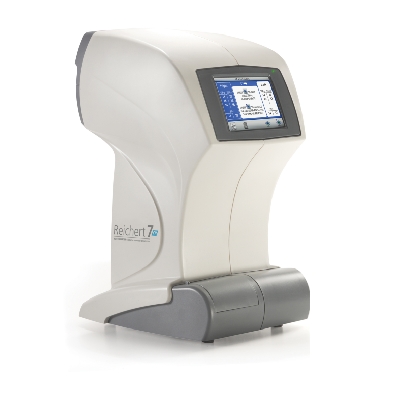
In my experience the best tonometers for home use (a.k.a., self-tonometry) are the Reichert AT555 and the Tiolat iCare. Of these the Reichert is much easier to use.
Today, miller13 said,
Had the proview: it never worked :(
I say that's no surprise! Thanks for reporting your experience.
miller13 also asked some questions about which tonometers are suitable for self-tonometry.
Now looking at the Diaton.You say No??
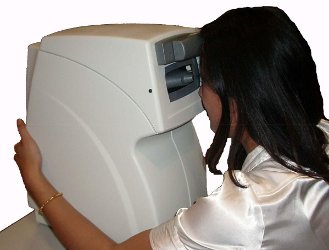
Is the Reichert an air puff tonometer?

Developing a Tiny Wireless Sensor to Monitor Glaucoma Around the Clock
The original article is found on the Howard Hughes Medical Institute (HHMI) website. HHMI investigator Simon W. M. John shares our perspective on intraocular pressure monitoring. He recognizes that intraocular pressure can vary quite a lot even in one day and that the value of measuring intraocular pressure only twice a year, as is typically done in practice, is very limited.
Grateful for Dave and self-tonometry!
Hello Members,
I have had my Reichert AT555 for two days now and taken taken quite a number of readings. Though my IOP does fluctuate, which I did understand is expected, I have seen much lower pressures than I thought I would! My opthalmologist's target pressure for me was 25 on Xalatan. I had frequent pressures of 30+ in his office but much lower numbers in my optometrists office (my friend). During the past two days I have seen only 1 average of 32 in 1 eye, and the majority of the time the IOP is mid 20s or lower (this is off medication). I have been off the Xalatan for the past month. Of course, now that I see my IOP can be even lower than his target of 25, I plan to work on obtaining this on a consistant basis (off medications).

My Personal Self-Tonometry Setup
Someone recently asked me where I keep my tonometer. When I started self-tonometry, I kept my tonometer in my office in a convenient location so that I could check my intraocular pressure while working without getting up from my desk. I could check my IOP while talking on the phone or using the computer, for example. At that time stress was one of my main research focuses and work was my main source of stress. Eventually, I achieved excellent management of my intraocular pressure during the work day and I began looking at my diurnal IOP curve more closely.

New iCare
Hello people,
Just wanted to let you all know that I have bought a new tonometer to carry with me while not at home using the AT555.
After long time discussing with David I have decided to buy a new iCare tonometer, it is very compact so can be used travelling and at work.

Pressure
Hello,
As mentioned I will discuss pressure today. I have a mechanical engineering background and process pressures is one of the parameters I work with every day.
The intraocular pressure of an eye, IOP, is measured in mmHg which stands for millimetre Mercury column. In the old days barometers were U shaped glass tubes filled with Mercury and the height of the Mercury indicated barometric pressure.
Diaton portable tonometer
Hi Dave and others
Can you give your opion on Diaton portable tonometer for home and personal use?
I dont know the cost. But sounds may not be that costly.
Paresh
Tono-Pen XL vs. Tono-Pen Avia
Dave, hello again,
Another question regarding tonometers. Can you comment on the differences between Tono-Pen XL and Tono-Pen Avia? The price difference is quite significant, while many other thing are quite the same. What do you think about Tono-Pen tonometers use for self-tonometry?
Thanks again.

The Pulsair-Keeler non-contact tonometer in self-tonometry: preliminary results.
EDITOR: this is a very old study. The tonometer discussed here (the original Keeler Pulsair) is no longer manufactured. The current Keeler Pulsair models do not work for self-tonometry due to design changes.